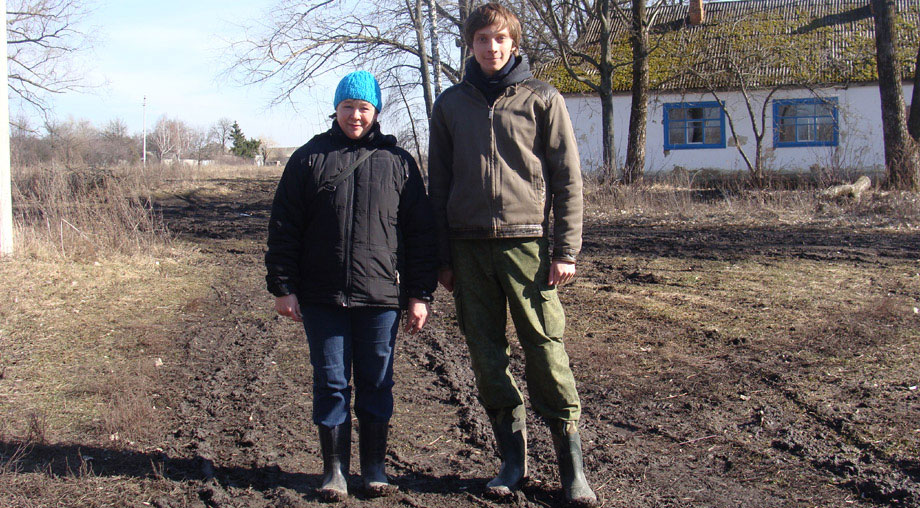
The heroes of the series – representatives of various professions – tell us about details of their job that has become their mission. We will spend this day with Nina Eskova, the postwoman of Rudavets village, Oboyan district, Kursk region.

The only paved road of Molodezhnaya ('Youth') street stretched alone across the village. The name of the high street has remained from the better times – now mostly aged people live here. The padlock emerged on the school door four years ago and has not been removed ever since, therefore slightly over 20 kids are taken to school to nearby Rudavskiy settlement. I am peering at buildings to no avail trying to find something remotely similar to a post office: a medical station, a culture centre, a village store... The pavement ends. "Turn here and you can only walk there", a picturesque old man instructed me on my way and smiled a gap-toothed smile in conclusion, "You're not wearin' sneakers, I hope, are you, city dwellers?"
More than just a Post Office
"306 246" is a well known, almost magical number for 430 inhabitants – it is their postcode. There is more to it than mail. Despite the fact that only high boots can get you there, the post office is an information centre, a call office, a social welfare office, the hub of the Universe and a plethora of other things. At least, when we arrived the road was seriously muddy. And nobody knows how many dry days are in a year here, nor does Nina Yeskova who has been distributing mail in the middle of nowhere five days a week for the last 17 years.
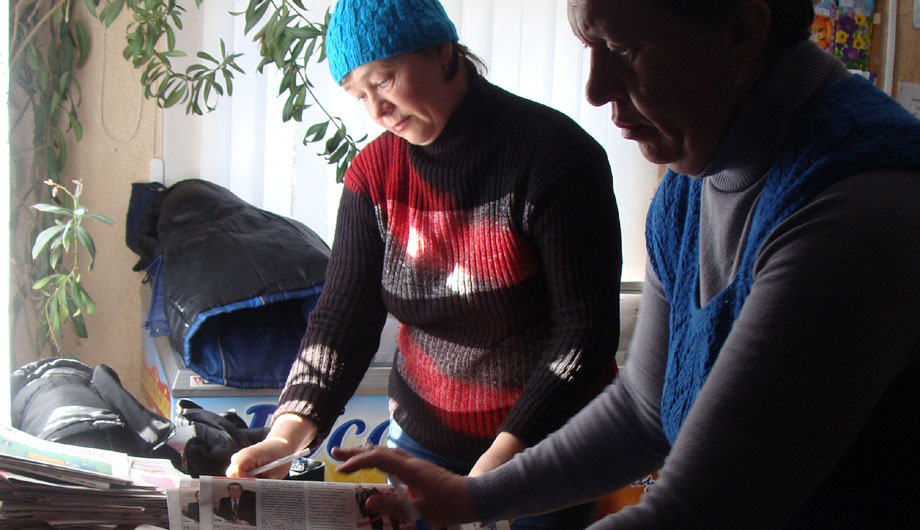
At noon she was already back at her working place. Nina was filling a "traveller" – a sort of itinerary list where all addressees are indicated. A young lady, Alena, acting head of the office, was busy with her computer nearby, making some reports. Then Tatyana, a second postwoman, came. Only three persons work in the 306 246 post office. Everybody was waiting for a van with mail.

A cornflower-blue van, popularly referred to as "buknanka" (brick bread), merrily rumbled in the yard and the brakes gave a loud squeal in a manner only UAZ vehicles can do. Before perestroika, the mail had been delivered to the community by Granpa Ponia and his horse but it has already been a quarter-century since a driver, Yuriy Annenkov, took this responsibility. "It's my fifth vehicle, it's been four years now", he proudly patted the van's shiny body. "I got used to blue mail vans way back when a student, and then I decided to come back here after army service to work as a driver. It will be 25 years this year that I've been working here!"
Meantime, a few hefty boxes were unloaded from the van. "Are these parcels?", I asked in surprise. No, it turned out to be bread. The counter in the post office is laden with foodstuff and manufactured commodities just like a normal shop.
Today is Friday and it is one of the busiest shifts because of the district mail delivery. Mail sorting did not take long. Eskova's mail bag weighed 4.5 kg. Well, we are to deliver 56 copies of Oboyanskaya Gazeta and two letters.
Sacred horizons
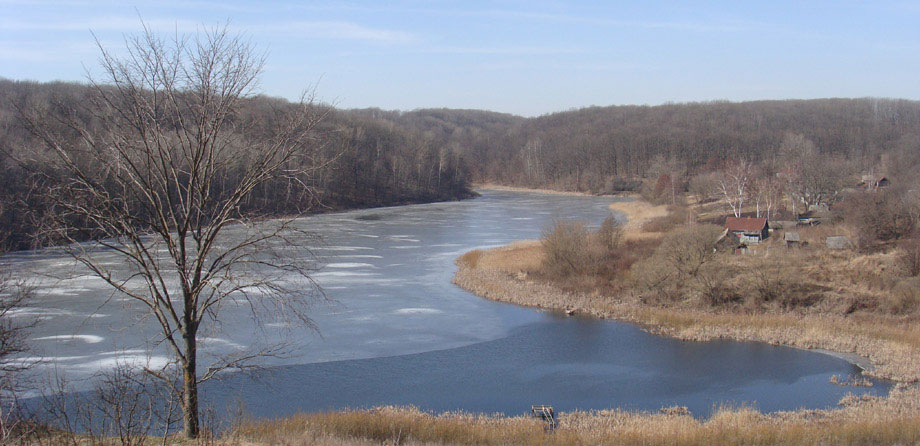
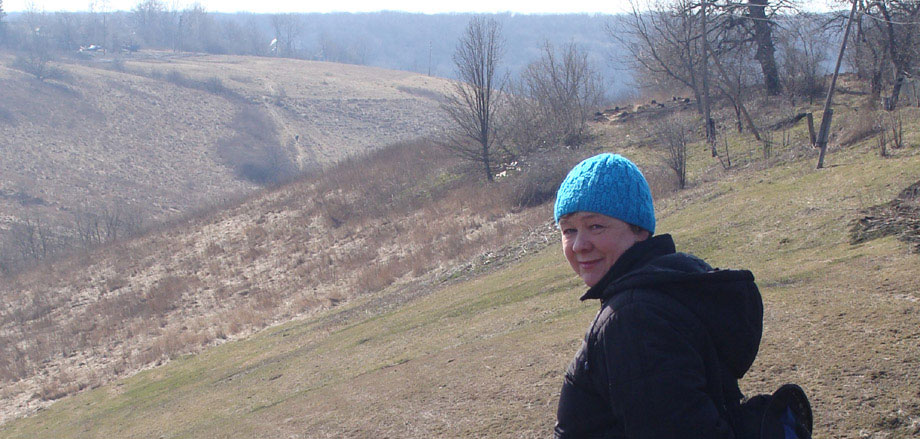
Rudavets boasts of a more than three century long history. The village has streets with distinctly unusual names, such as Gurovka, Kalinovka, Rozhka,Kolbasovka and landscape scenery Switzerland could envy. And it is not a big deal that there is knee-deep mud when it is fertile black soil. "Yesterday, I slipped on a hill, fell in mud and got wet", says Nina. Smiling upon this account, she must be a true optimist.
Anything goes with this job. Dogs barked at us when we approached first houses with Zhuchka being nastiest – it nearly bit the postwoman's rubber boot. In other words, everything went as it should and even the weather was benevolent to us: a picturesque pond, called Tsigarikha by locals, sparkled in the sun. A red-haired boy was walking on a wooden bridge – the shortest way to the nearby village; a little man was fishing on thin ice.
An old woman stood up to meet us halfway. The postwoman handed her a newspaper and asked, "Did the fox show up again?" "No, still keepin' watch (Author: she really said "keepin' watch"), she replied and said to me, "Foxes ain't uncommon down here, killed half o' my chickens."

Visits of wild animals are no surprise here. "Wild boars don't come any more", says Eskova, "but several months ago my husband Yura encountered a roe deer near the pond. Not once did we find young hares when we were weeding beets. We would keep and bring them up in and then let them go."
The path of the postwoman goes up and down through a tangle of briars past a patch of wild strawberry. Uncle Sasha who used to live in Rozhok street, once, much to everyone's delight, planted a park of 20 trees: jasmine, birch, black cherry, linden, spruce... The old man passed away and tall weeds and nettle colonized the garden. The same goes on on the path along a ravine – the nature takes its own. Out of 200 households in Nina's distribution area, less than a half remained inhabited but to say that the village dies out would be premature. The villagers fight with advancing forest for each square foot of land and they are determined to win.
"How do you prefer to be robbed?" a grey-haired man with a saw in his hand gave me a wink, apparently seeing the postwoman with an assistant for the first time. "I'm gonna have to go and get a gun to take out one an rob the other!" When Yuriy Ryzhenkov retired, he decided to relocate from Oboyan to his parents' home. Working as a tractor driver, he always helped old lonely folks by ploughing their vegetable patches but now he cut out derelict growth along a country road from the morning till night.
The All-Russian Off-road Postwoman
The villagers comradely and affectionately call her Ninochka. Naturally, they also called her Postman Pechkin (a well-known character of stories by Eduard Uspenskiy, a children's writer, and cartoons made after them), especially, when she was riding a bicycle. And kids usually start yelling gladly "Letters come!" when they see her from a distance. People just can't wait. If Nina is late they are anxious. It is not about fresh newspapers, nor is it the pension she brings. It is about having a word with the postwoman, it is about a brief chat on a zavalinka (a protective mound of earth around a Russian peasant house), and it is about asking to say "hello" to a neighbour. Nina shares grief and joy with her villagers and is always ready to give a hand: to address a letter, buy food, screw in a light bulb, give an injection... Once she even helped to push a car, "Where you are, my dears, going in such wet weather, I wonder..." Only one off-roader can challenge local roads in any weather, be it rain or a snow fall – the Russian postwoman.
She can hardly imagine her life without this job now, though had never thought of it before. After her 8th grade year of secondary school, she entered a teacher training college and upon graduation worked as a nursery teacher for five years until the kindergarten was closed. In the 90s, Nina used to go to Kursk to sell milk but she felt uneasy in the hustle of the city and her heart belonged in her home village. However it was not easy to find a job here because the only state owned farm was disorganised. An opportunity turned up.
"Our postwoman, Aunt Marusya asked to substitute her during her vacation", she remembered. "It was August; my first working day was very warm. It was unusual and I was at a loss 'cause I didn't know all villagers' patronymics not to mention their family names. But I realized it was my thing: talking to people and always on the run, you know, ten kilometres a day on foot is the best fitness. When Aunt Marusya retired I replaced her."
Before holidays, Nina Eskova spends all her spare time in a community club, rehearsing for concerts. She is into singing. Maybe she would not have been the best postwoman of the year in 2012, had it not been for her beautiful voice. The final of professional skills competition took place in Moscow. An anchorman from Channel One, Andrei Malakhov, was the presenter of the event. According to the conditions of the competition, the participants were to prepare a number of creative performance. Nina chose a song. As a true postwoman, the native of Kursk region appeared on the stage on a bicycle. But since she did win she drove away on a prize car.
Nina Eskova owes her creativity to her parents – Valentina and Ivan Ryzhenkovs. Her father used to be a combine operator, and he was awarded orders in recognition of excellent results of his labour activity. He also became an honorary citizen of Oboyan. He was no less passionate about amateur performances and focused on choir singing. Ivan would often take his daughter to the club. The Ryzhenkovs were also one of the families who read a lot. "When I was child, the postman's job was no easy", she smiles, "People used to subscribe to around ten magazines."
Where unseen roads wind
We put a next newspaper in... a bag for flour that was hanging on the fence on top of which a huge cat watched us closely. Smart camouflage for a mailbox, that is. Is this habit a legacy of the Great Patriotic War? During the Great Patriotic War, the village was occupied by Germans who then converted the local horse barn into a hospital. "Imagine what heavy battles were going on here in 1943 if we still find cartridges in vegetable gardens", – noted the postwoman and suddenly stopped and waving her hand towards some direction continued, "See the house in the end of Kolbasovka street, Anna Nikiforovna lives there. She is already 90. She came here on foot from Kiyv in the war time. And she continues to be amazed how the life is good now. She may compare." The villagers miss the church destroyed in troubled years – they installed a memorial cross instead. The faith is strong here: almost each household has an icon of Saint Nicholas and an icon of the Mother of God.
All of a sudden, a strong gust of ice-cold wind blew from the side of a forest. "Some forest", Nina said mysteriously, "We call it Rog. There used to be an old road along it, and they say, Catherine the Great once travelled there. Many wagon trains and horse carriages with noblemen used to pass by. And they were targets for rogues who lived in the forest. As an old legend has it, the rogues hid pillaged gold somewhere deep in the forest. My 84-year old neighbour told me this story and he, in his turn, had heard it from his forefathers. And they all endeavoured to find these treasures".
Some time ago a witchdoctor lived here. People were a bit afraid of him – he could charm away any animal. White witches, folk healers still exist in Rudavets: they heal non-healing wounds, drip hot wax into holy water to cure fear and the evil eye.
Some invisible magic guards the Russian village. Nothing can make Nicolay Zayikin, a man impressive in everything, a dedicated communist and former Party organizer, change his old-fashioned habit to wear a fedora and a neatly-ironed grey costume on all occasions. Nor can anything keep a local museum curator, Nina Karnaukhova, from gleaning facts about the history of Rudavets, and from organizing new meet-the-artist events for her villagers with their renown fellow-countrymen – Anatoly Selivanov, a poet, and Vyacheslav Nesterov, an artist, both of whom glorify their small motherland in poetry and paintings. Again and again, Georgiy Polianskiy will be coming back from the pond pressing a bundle of wicker with his only hand to his chest, and will spend long evenings weaving baskets. And a former collective farm agronomist, Aleksey Ivakin, will build a couple or more greenhouses where he will be growing even more onions thus requiring more hands and somebody will find a job.
And a Christmas carol will knock on every door on the Christmas Eve, and a straw man will be burning on Butter Week. Our postwoman, Nina Eskova and her sons will be among those who, according to some ancient tradition, will roll burning wheels downhill. And old women, sitting on a zavalinka, will be worrying whether potato harvest will be good. Of course, the whole village will get together after the harvest time. Big celebration. A street-long table laden with home-made pies, pickles, meat in jelly, bowls with sauerkraut will be set. Granpa Vasiliy, grunting, will have a shot of home-made vodka and then will produce his concertina. A song, some evergreen melody, will flow towards the horizon. Here, in Kursk backwoods, the true Russia spirit lives.