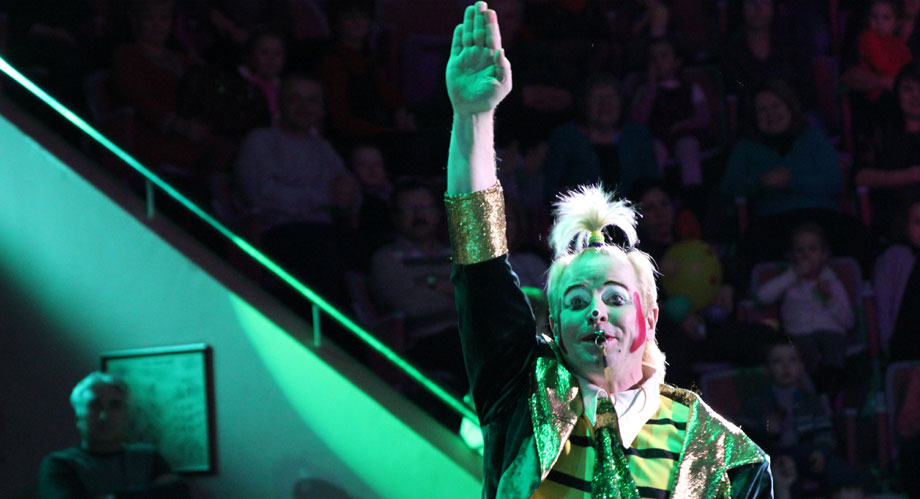
The heroes of the series – representatives of various professions tell us about details of their job that has become their mission. We will spend this day with Eugene Chepchenko... a circus clown.
We enter the sancta sanctorum of Kursk Circus, which is the backstage, from a service entrance. "Be careful not drop in unexpectedly in a pen for predators", says a kind security guard, giving us way to labyrinth-like corridors. We adapt to local smells of wood chips, horse barn and wet dogs, and move along toward noise: sea lions roar somewhere in the depth. A woman wearing a chef's hat and carrying two buckets full of carrots rushes past us and disappears behind a door with a plate reading "Kitchen for animals". A rehearsal ring, a bar for performers, dressing rooms, rooms for service personnel... Here we are in front of the roaring and snorting crates. To play it safe, we keep clear from them.
It is still over two hours before the show but preparations are already in a full swing. We walk along the central aisle between camels in kerchiefs, horses and warming up acrobats. Finally, we reach the main circus ring. The hero of our article Russia's Honoured Artist Eugene Chepchenko discusses something with a lighting designer and a sound director. Then he goes down to an orchestra pit to instruct musicians after which reprise they should insert drumbeat. His plain sweater and jeans are difficult to associate with his stage image. But in any case, this smiley fair-haired man is a clown.
Amused Them Out of Fear
Though most of this circus skill's artists prefer to be euphemistically called "carpet performers", as it is indicated in their service record, Eugene takes it easy when he is addressed to as "clown". It was the same when he was a boy. While other kids thought of going to space, putting on general's epaulettes or learn to dance ballet, Eugene dreamt of amusing people on a circus ring. He liked to cause people's smiles when he was in kindergarten. But the true "circus" happened when he was in school. The class, accustomed to his pranks, was always eager to see what was next he was up to: be it pulling a face, a painting of something funny on a blackboard or putting a petard under a teacher's chair. However, teachers did not share the children's enthusiasm and his homework record book was regularly filled with reprimands.
His parents noticed that the boy meticulously collected newspaper and magazine clippings pertaining to circus, and how he admired Yuri Nikulin and Oleg Popov. Therefore, when they sorted out what was going on they did not punish him strictly for school defaults because they understood that one of five brothers in their large family was going to be an artist. Eugene's parents worked at Kursk Knitwear Factory. His mother was a warehouse attendant and his father was a mould operator in a cast shop. Despite the fact that they were not particularly good at arts, they sent him to circus courses.
"There they explained me that the clown's skill was one of the most difficult one. That is why a clown must be able to do everything," says Eugene while tying a balloon required for some reprise. "So, I studied juggling, acrobatics, animal training, choreography, vocalism. I also spent much time studying illusionist's skill. I had my debut performance in public at the age of 12. I participated in a concert program of RTI Plant's recreation centre where I staged a trick in which I sawed a female assistant and divided her into several pieces moving in different directions. In general, everything went smoothly, but my Granny, who were present among the spectators, often pressed her hand to her heart and swallowed medicine.
It seemed impossible to become a professional artist without proper connections. After high school, Eugene went to Kyiv, the capital of Ukraine, to go to an aviation college. But when he with his father walked down a street, he saw Kyiv Circus. A circus college was in the same building. The father, aware of his son's dream, encouraged: "Shall we try?"
"It was no less difficult to get there than to join aviation," the native of Kursk wonders. "The circus colleges of Kyiv and Moscow were the most prestigious ones in the USSR. Therefore, the competition for the clown's skill training course was about 20 candidates per one student place. I went through three selection rounds, a thorough medical screening, and passed exams in various subjects... I was given a number of tricky tasks to be prepared for creative competition. For instance, one of them was to mime a hose and a padlock. I did not know how to do that and did not train that, but I succeeded out of fear." Boris Potashnik had become Eugene's main mentor for all four years to come. He used to explain him how to communicate with trees and understand the nature... They did not teach the clown's skill there. They say, you are either gifted with it or not.
In the Tiger's Jaws
Without a make-up and still unrecognisable, the clown came out to a lobby. He looked out of a lobby window and saw first spectators walking on snow mush. It is harder to make audience laugh when the weather is gloomy rather than sunny. But Eugene Chepchenko thinks positive: it will take him an act or two to cheer the people up.
Carousels started spinning, a queue for cotton candy and popcorn lined up, vendors of toys and balloons livened up. White poodles, posing for photo cameras, wag their tails before little circus goers. The place grows crowded. Children and grown-ups have come to have a feast...
Who will amuse the clown if he feels blue? There are such people. During so-called "green" final shows, artists have a tradition to prank with one another. When this happens, audience is unaware that everything is not according to plan. Unexpected replacement of a backing track is the least prank of circus folks. "When on tour in Odessa, I had an act when I jumped on a skipping rope with a drinking glass on my forehead," remembers Eugene. "Before the act I would pour water in a glass and would drink it to show that it was real. That time I filled a glass as usual and smelt that something was wrong. Pure alcohol! How was I going to drink it? I was up to the task: I cast a glance around the audience for a man. "Will you drink?" I asked. "OK" he replied. He must have remembered that for a long time. He also thought it was water."

Once it was for serious. Alexei Konstaninovsky, whose parents were starred in comedy film "Striped Trip", played a prank on him. Standing in a cage, Eugene Chepchenko called an animal tamer assistant from the audience hall and blindfolded him to play blind man's bluff. At this moment, tigers were released out to the arena. There should have been a ladder hung for him to climb quickly after the coming out of predators. But this time the ladder was absent and a she-tiger approached him closely. The scared artist only had time to lie down with his arms under his body when the 200-kg wild cat closed in on him and grabbed his neck with her teeth. He said farewell to his relatives in his thought and his whole life flashed before his eyes. Then the tamer rushed to them just in time to drive the animal away. She-tiger Dyna was among Konstaninovsky's favourites because he raised her at his home and never doubted her friendliness. However, the poor clown has kept away from this species ever since.
Today's program does not involve tigers. The third bell has rung. The lights have gone down and music has played. In 1973, Kursk Circus was still very new. 4-year old Eugene sat on his father's lap in the first row. The kid admired his first experience of this magic world. A man, wearing colourful garments with a red nose, came out on the ring after an act of gymnastics. Laughing, he pretended that he poured water in a bucket and splashed it out to the place where the father and the son were sitting. But instead of expected water, they were engulfed in glitter paper streamers. Eugene cried because the clown scared him...
During his appearance in the first part of the show, Chepchenko mingles with the audience. The clown tries to read their faces, their reactions to jokes – he decides who will be apt for a reprise and who will not. In his day, Eugene also majored in psychology in Kyiv University. This additional education is helpful because he prefers live improvisation to a "plant" among audience. Even the maestro of the clown's skill Yury Nikulin could not find a catch when he watched a video tape with Chepchenko's shows. "Sometimes I hear that people do not want to buy tickets for first rows because it is thought that a clown can take them out to the arena," says the native of Kursk. "But I think to myself: I will get you even on the gallery!"
Transformation in the Make-up Room
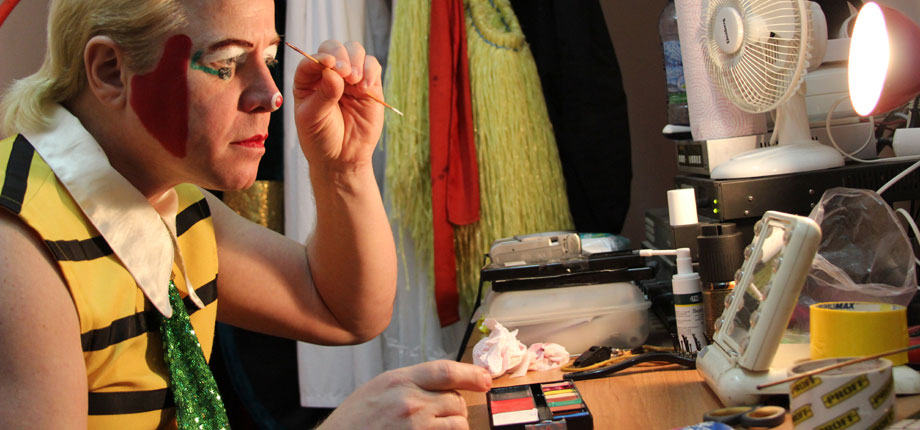
There are red-yellow boots, a hanger with attires for the show: a wedding gown, a white coat, bowknots and other things. The owner crams his stage property in one suitcase. During an intermission, Eugene has only 20 minutes to transform into a clown's image. He puts on a "bee's" jacket, an emerald-green tail coat, dotted trousers, and then makes his signature palm bunch on his head and starts making himself up. No fake nose, the emphasis is on large kind eyes. A mirror with built-in lamps, bought in a theatre shop in Paris in 1998, as well as sponges, brushes and paints are always at his disposal... Sometimes he has to perform in hot African countries and in the Middle East. The standard chalk-based make-up would run instantly, so the artist always uses the Vaseline-based Leningrad make-up. One could bathe in it – no surprise it is valued around the world.
The cloakroom has a small icon, though this is contradictory since the circus folks equally believe in superstitions and in God. Eugene Chepchenko has been at the big top of the circus at a height of 30 meters not once. Frequent flights also pose a danger. "Out troop was coming back to Moscow from Buenos Aires," remembers the artist. "The aircraft with three hundred passengers on board broke down – one turbine failed. Alternatively switching remaining engines on and off, the crew straightened the aircraft up and made an emergency landing on the Cape Verde Islands. Later, a stewardess gave it away that the Captain had grown pale like the rising moon and smoked a Russian Belomor cigarette."
Pictures of his wife Lena and their 22-year old son Dima, a computer designer, occupy the most important place on his desk in the make-up room. The clown from Kursk met Elena Ivanova, a woman gymnast, in the circus college. He shared the same desk with her and did not know that it was his future wife nearby. They married when he returned from army service. What was his army service like? "Military men were sure that since I was an actor then I must have been a shirker," smiles the artist. Once I was sent to a pigsty to load manure. They thought I would work with my nose pressed with my fingers. As a matter of fact, I did the job fast and lay down to suntan. It's no wonder, I spent each summer in a countryside setting near Kursk in childhood.
To Be a Clown till the End!
Eugene Chepchenko rarely sees his family. Their house is in Zaporozhye, Ukraine, in Elena's homeland. "Husband for 90 days," the clown usually jokes away when a border guard asks him about a purpose of his visit to Ukraine. According to regulations, he may stay in the neighbourhood state only for three months. However, under the given busy schedule of his tours, the travelling artist is glad when he has an opportunity to spend at least a fortnight with them.
In April, Eugene will go for a big tour with his wife across the Baltic States. Besides, they will take their son with them. To this day, they have nearly always been in different troops. He toured most during those 13 years when he worked in Big Moscow State Circus. He did not visit only Australia over that period.
Once in Latin America, where for his moonwalk skills he received a moniker like Michael Jackson, he had an exciting encounter. "We finished our tour in Argentine and stopped by Paraguay's capital Asuncion for two weeks. When I had dinner in a cafe, one hairy man sat at my table. "Moscow Circus?" the man asked me. I nodded positively. With each beer, I spoke Spanish better than before. The stranger invited me for the best city pub crawl. He had a car with a personal driver. We stopped by one bar, people applauded him, and he sang something. His voice was pleasant and seemed familiar. He must be an opera singer since he is known in Asuncion, I thought to myself. Everything was on the house. Then we proceeded to another bar. In this manner, we started at 9 o’clock in the evening and he brought me to my hotel by morning.
When I returned to Argentina, I switched on TV and saw a Bamboleo music video on MTV channel. My wife used to perform to that track, so I decided to watch it completely. Well… I recognized Nicolas Reyes, the lead singer of band Gypsy Kings... When we parted he slid a business card in my pocket."
The USA, the Arab Emirates, Great Britain, Chile... In Tokyo, when Eugene rested in a hotel room on the 18th floor, he woke up because the tall building rocked like hell. An earthquake occurred. In Bangkok, on his 33-year birthday, he received a government telegram signed by Russian President Putin stating that he had been awarded the title of Russia's Honoured Artist.
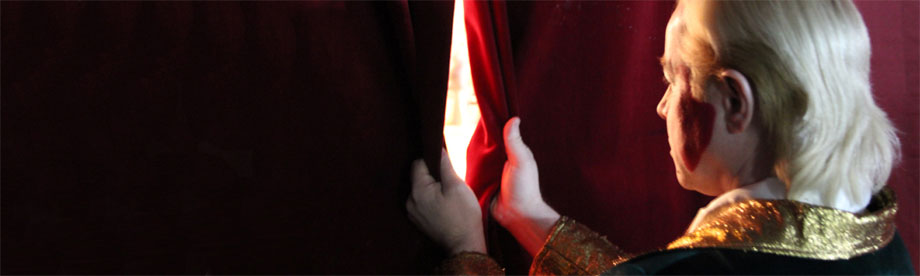
It is his turn to go out on the ring now. Eugene Chepchenko opens the second part of the show. He has made over eight thousand appearances on stage, and each time he still feels anxiety. But it is over as soon as he makes the first step into the ring... After the show, children grasp his hands, hug him, and ask to make a joint picture. It must be a true recognition... The dream of childhood has come true and what else? While removing his make-up, a potential Harlequin goes: "Maybe I should head some depressive circus, attract top-class artists, and stage a brilliant show. I should take more risks... Since I am a clown I should be a clown till the end!"