The heroes of the series – representatives of various professions tell us about details of their job that has become their mission. We spent one day with Vladimir Pridvorov, a camera man, who makes documentaries for central TV channels.
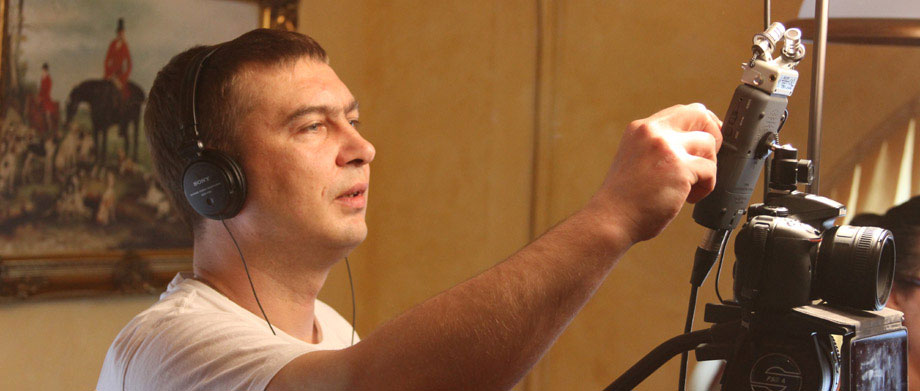
"What do you see?" Pridvorov points at a children's playground in a park where kids are playing. I can see nothing special there. "It is possible to shoot this action from five cameras: a panoramic scene, then the view is broken down into close-ups, and then dialogues inserted separately..."
In a Picture with Youth
A kitchen in one of Kursk's tower blocks is inundated with flavours of fresh edible greens, laurel and crisp bits of golden fried pork fat. Just as a film's decent storyline is made out of separate shots, so a chaos of vegetables, spices and other ingredients gives rise to a masterpiece, a culinary one this time. Borsch soup enticingly steams on a table as if inviting the amateur cook who has left his job earlier today for the sake of cooking...
An unexpected phone call from Moscow has dispersed this gastronomic harmony. "This is Channel One speaking, we need a story..." a voice in a handset sounded in a business-like manner. It is urgent, of course. The forgotten intact borsch has cooled down completely. The man rummages through his telephone book, calling around all people who may know something about a 7-year old lucky girl who has survived after falling down from the 9th floor. It all happened several hours ago.
Vladimir Pridvorov has gained an impeccable professional reputation over his 20-year experience. Whatever happens in Kursk, he receives calls from all central channels: Channel One, Rossiya, NTV and TV-Centre. By the evening, all the views from the scene of the accident have been sent to Ostankino TV centre.
He has had a dream to be a camera man as far back as he can remember. Even when he was 4-5, while other kids sculpted animals and soldiers out of modelling clay, he modelled vehicles that he pretended as if they ran about and filmed news. The Pridvorovs' house was always full of interesting characters: prominent Kursk painters, sculptors, journalists... After graduation from the Faculty of Arts, Vladimir's father, Nikolai, drew posters for Oktiabr' cinema theatre, and he worked as a photo reporter in a local newspaper in his last years.
Pridvorov Jr. inherited a sense of view and composition. He made his first steps with a simple point-and-shoot camera called Vilia-Auto that was manufactured in Belarus. A film for camera cost 35 kopecks then. When he was 12, he wasted heaps of photo paper and chemical agents – it seemed to him the results were not good. But on the other hand when he was in the upper school he worked as a photographer in a photo shop during a school break, simultaneously making commercials for city buses. During the summer, he managed to save money for a tape-recorder and an amplifier with big speakers, a dream of all his coevals at the time. Prominent photographer Gennady Bodrov, a master of his craft, mentored him.
And still this has remained just his hobby. Today, Vladimir Pridvorov also takes a photo camera with him to spend time in the out-of-doors to relax from daily fuss. His vocation turned out to be similar though he became a camera man almost by chance.
New Era of Television
"A feeling of freedom, Perestroika, the August Coup – the television reflected the changes in society like nothing else could," Vladimir says. "A true information revolution was taking place and I wanted to be a part of it." But there was nowhere to study this profession in Kursk, neither had my family money to send me to another city. As a result, I ended up in a medical college that later I quit after two years. One encounter changed it all."
Once at a bard's festival, Vladimir Pridvorov met one man while sitting around a bonfire and singing songs. The man was setting up new television company TViRS in Kursk. Vladimir mentioned that he loved to take pictures. A month after, a cameraman's job was offered to him.
In 1995, there was an ecological forum in Kursk that was attended by the former USSR President Mikhail Gorbachev. Novice Pridvorov, unaware of VIP attendance there, was sent to cover the event. The young cameraman was at a loss when he saw the then General Secretary. The conference already finished but he still continued to roll until Gorbachev himself came to him and shut the camera lens with a cap and said jokingly: "Save film!"
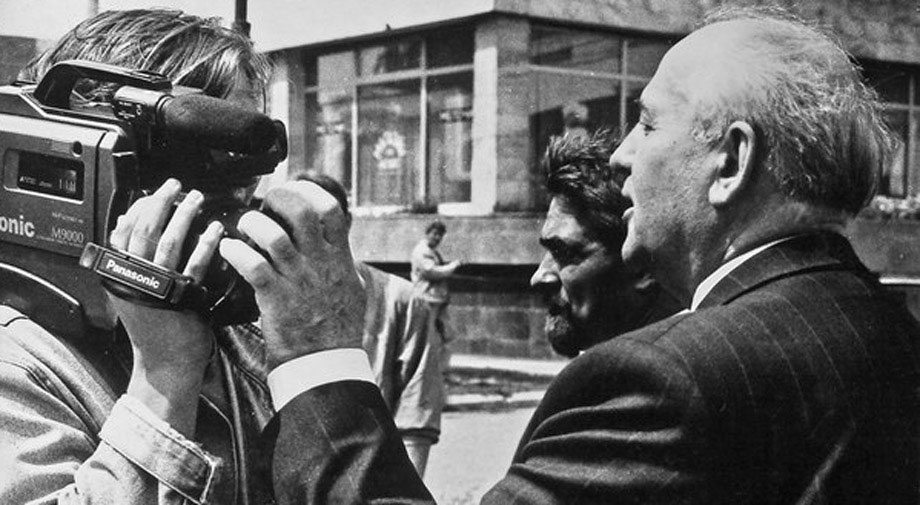
Novice Pridvorov continued to roll until Gorbachev himself came to him (photo by Georgy Gongolevich)
TViRS company had existed until 1997, but Pridvorov did not stay without occupation later. He then used to work for Kursk TV channel TV-6 and for Regional Administration. He obtained his own video camera in 1998. Vladimir gradually filled the gap in his education: he graduated from a faculty of journalism, finished a special training course conducted by American "hot spot" stringers in Kazan, and took lessons in Moscow from Dmitry Mishin, a famous Russian cameraman. He also met Vitaly Peresipkin from Moscow motion-picture company called Masterskaya at one of trainings. It was him who opened the door to the central television for Vladimir when he invited him to shoot a documentary about Solovetsky Monastery in 2009.
The World through the Eyes of the Cameraman
"An official video from police is already available. The girl was operated yesterday; I will try to talk with medics." Pridvorov has been constantly on the phone and on the move since the morning. He warms up his car while listening to instructions from the press-service of Channel One: at the same time, coverage of Kursk Fashion Week is planned at midday today. We go to the site.
It takes one look for him to see in what point a camera should be fixed and at what angle to shoot, where the light and viewpoint are best, how to set up a composition and estimate a focal distance in shot. Viewers' impressions from a completed work depend on Vladimir's expertise in all these nuances because we watch the screen through cameraman's eyes. It is in his power to make a person younger or, otherwise, older. A cameraman can remove or emphasize drawbacks.
"The most difficult thing is to deal with women after 40, they are more prone not to like themselves from outside," Vladimir says. "There are special filters than can remove wrinkles and a double chin. Such ones are used in motion pictures. Otherwise, it is possible to use a reverse effect to compromise somebody. We have a professional joke about this: one cameraman asks another one if his wife is beautiful. The other cameraman responds: "It depends how you set up the lights..."
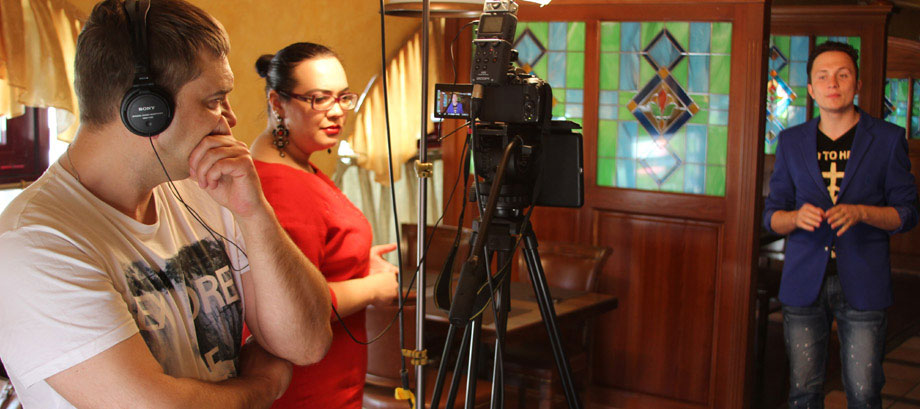
Batteries are charged and a flash memory is inserted. Pridvorov adjusted a lighting umbrella and a microphone, turned on a television prompter and nodded a TV presenter to start: "Hello! My name is Dima Gladkikh. Today we will learn the best kept secrets..."
Two hours later, after corrections and three takes have been made, the "raw" material has been ready. Vladimir dismantles the set-up, winds cables back and puts a tripod in a case. He bought the tripod in New York in 2011 and has taken it with him for all his missions ever since, which he has had quite a few. For example, he filmed a documentary about an overseas Orthodox Centre in the USA. In two week's time, he visited not only Jordanville where Holy Trinity Monastery was, but also the Great Lakes, Washington, Little Falls and the peaceful village of Cooperstown, the homeland of James Fenimore Cooper, the classic of exciting adventure literature.
We put bags with the hardware back in the trunk. One bag still carries a label of Sheremetyevo airport. "I did not have time to tear it off," the native of Kursk explains. They had film shoots of Orthodox Encyclopaedia program for TV-Centre channel a month ago. Previous 30-minute documentaries of this series gave an account of temples in Georgia, Spain and Bulgaria. Vladimir participated in all those trips. He also made a similar type short movie in Moldova by an order from Soyuz TV channel.
On the Other Side of the Screen
He always works with a team of professionals. Only once he departed for a long journey alone without a director, a scriptwriter, and an interpreter. He had to film the final scene of dramatic documentary Racers by director Daniel Nikulin on the go-cart track of the Belgium town of Spa.
The most memorable trip was to Sakhalin four years ago. The television crew witnessed emergence of a new monastery in a community detached from civilization and transport communications on the shore of Tatar Strait. "The island's nature's unique," Pridvorov says. "But local roads left much to be desired. It took ten hours to drive 200 kilometres. Red dust flew up all the time, so we had to wrap up our gear in plastic."
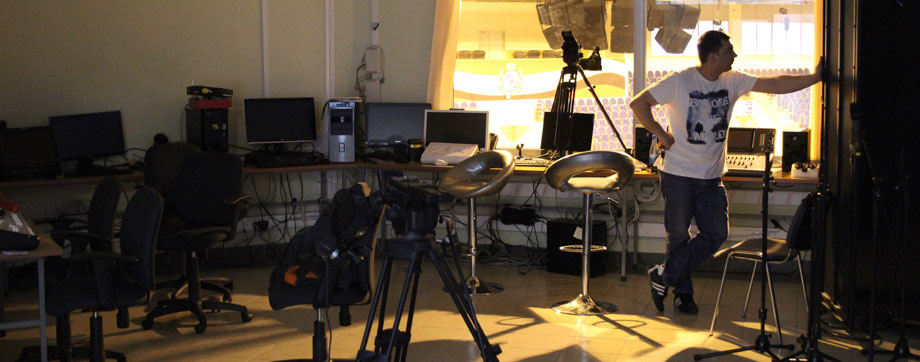
...A server, computers, sound mixers, microphone and light control panels, multiformat monitors and other electronic equipment are in front of us – we are in the heart of Sports and Concert Complex, in its control room. From here, the concert hall that can sit 3000 people spreads before the eyes. Pridvorov has been working this job full time for two years since he was invited to set up the equipment here. He is responsible for broadcasts of basketball matches, forums, and other recreational and educational activities. The picture is broadcast to a mediacube located in the centre of SCC, as live transmission to Kursk television channels and even abroad. At least it was so when women's Dinamo basketball team had a match with a team from France in the last season. Those broadcasts along with the Spanish ones have been among the best in Euro league.
An international press pass and, in no small measure, the magic phrase "Channel One" make our movement in the restricted area of a clinical hospital easier. However friendly the chief doctor is, neither of medics in charge of the girl gives us any comments – they have been prohibited "from the top". They allow us to film only near the intensive care. Anyway, the piece appears in the main Russian news program Vremya ("Time").
In December of 1996, when Kursk circus was on fire, Vladimir Pridvorov arrived there among the first. He got into a hell-fire with his camera. The footage that was then shown on NTV channel nearly cost him life. A glass flooring above him suddenly collapsed and cut a fire hydrant clean right where he had been a moment ago. Sometimes he has to risk for the sake of dramatic shots, but audience little knows what goes on the other side of the screen.


